
Christopher Nolan's Odyssey [review]
A review, as if you needed another

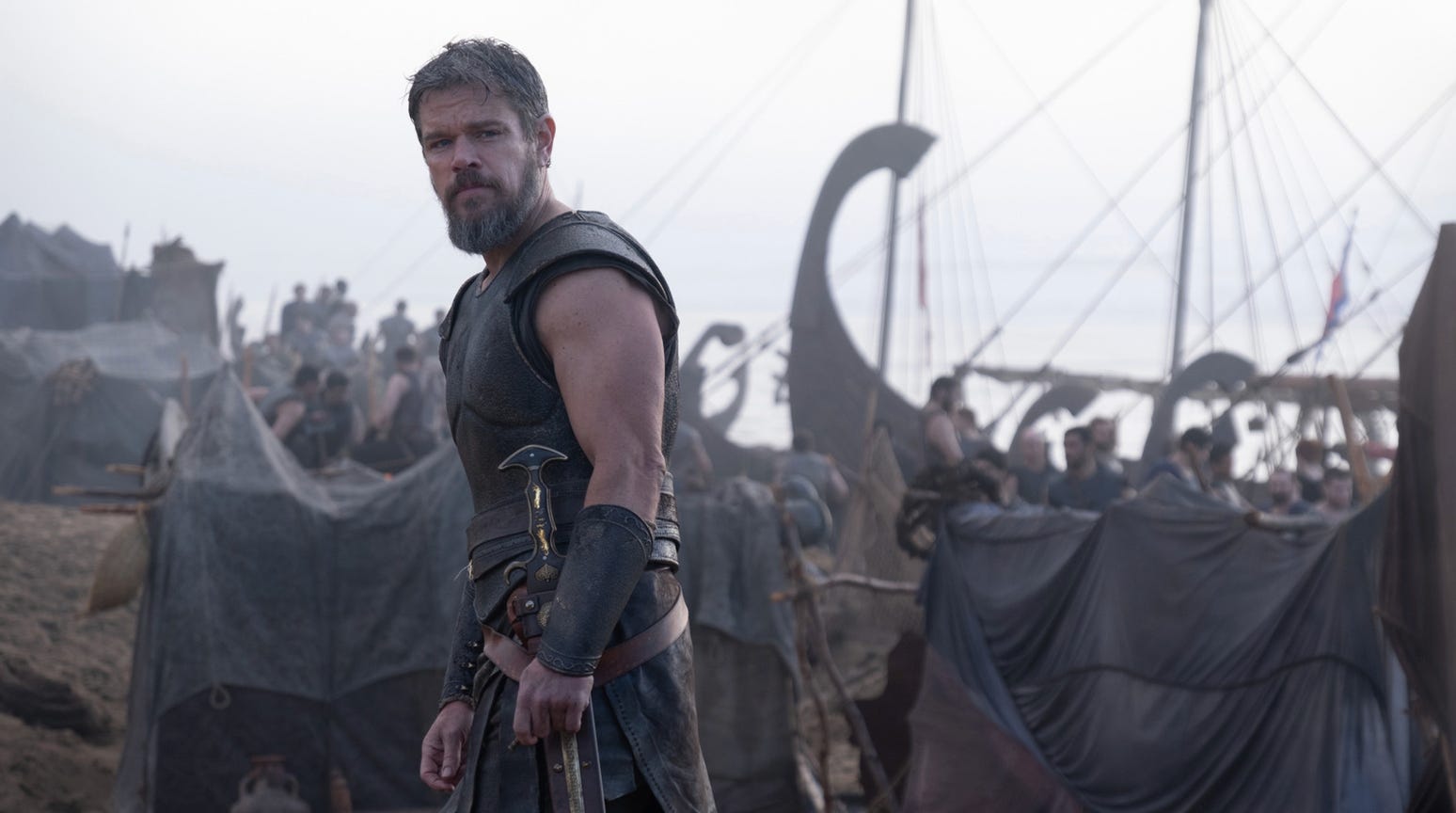
I wasn’t expecting to enjoy, or even to vaguely like Christopher Nolan’s new version of The Odyssey. I remember enjoying the trickery of Memento, but I found Tenet utterly baffling, and I was dreading that he would perform something similar with this ancient tale, sucking all the glorious life from it, rendering it into a frantic, breathless and dreary mess.
But it was not so. Instead, I found myself gripped, frightened and deeply moved. Some of the most well-known episodes of the story thrum with a tension that hardly lets up. Because of this, I can - just about - forgive the film’s strange, washed-out palette of tones, and its Game of Thrones aesthetics, all quasi-mediaeval costumes and banners fluttering on battlements. It hits quite a few of the “fantasy film” clichés, too: there were flowing dresses, lots of staring out to sea over said battlements, quaffing, and someone even ate an apple piece by piece with a knife. (Did the Ancient Greeks have apples? I actually have no idea.) I can also just about forgive its really quite odd casting: we are supposed to believe that the finely-featured Tom Holland is Matt Damon’s son? Perhaps he gets his looks from his mother (Anne Hathaway: a solid performance, by the way).
I’m not the sort of person who particularly minds about “authenticity” in casting, especially with a text that features a one eyed giant, but I did find the general mixing of ethnicities a tad pointless. The suitors in particular seemed as if they were members of Starfleet in a hologram version of The Odyssey, and Robert Pattinson as the suitor Antinous has wandered in from a version of Robin Hood. The film-makers missed a trick in not using the Trojans’ Ethiopian allies, and their leader, Memnon, prince of the Dawn.
Helen, in the Odyssey, is a powerful queen with secret Egyptian knowledge: I thought they could have given more for her to do here, but I liked the emphasis on her relationship to her sister, Clytemnestra, and the homecoming of Agamemnon (whose face we never see, weirdly: I did wonder why this was so. He’s always helmeted or seen from the back.) The nostoi (homecomings) run parallel to each other, across the expanse of the Mediterranean: Agamemnon is murdered by Clytemnestra; Menelaus and Helen live in harmony; Nestor returns safely; Ajax is wrecked; Neoptolemus marries Andromache. (I am very interested in the family relationships of the Greek heroes, and they are all related.) These are all possible routes for Odysseus, and I thought this mirroring was particularly well-handled, especially when the shade of Agamemnon warns Odysseus of his possible fate.
The episodes in which Odysseus finds himself entangled are generally repetitive, even in the poem: they land on an island, find a monster, and retreat to their boats. I expect this is partly why the Lotus Eaters were left out, as were the Phaeacians and Aeolus, and partly so in order to avoid an even longer film. Nolan handles the remaining, most famous episodes, with aplomb. The Cyclops, with its mangled face (a mauled soldier?), was decidedly horrifying, as was Scylla, whose terrible limbs we only caught a glimpse of, grey and flaky like a monster from Stranger Things. The sailors’ encounter with Circe was genuinely strange and unsettling, with Samantha Morton as a kind of 16th century pagan witch transported to the ancient world, physically metamorphosing the men into pigs with her bare hands. It was brutal, and highly effective, almost like Cronenbergian body-horror. The scene with the Sirens entirely emphasised their destructive power, yet I was a little disappointed that they were simply depicted as mermaids. (Also, Odysseus, you’re wrong! You’re not the only person who’s heard the Sirens - Orpheus did. Well, he went past them first, anyway, drowning out their song with his lyre.)
When Odysseus reaches the land of the dead, and talks to the shades, it was mesmerising, with the blind seer Teiresias appearing to be part of the earth itself, and the unnumbered dead ranging behind them. The scenes at Troy, I thought (clearly taken from the Aeneid), were also immensely powerful. I have (as I imagine have many classicists) often puzzled over the physics of the Trojan horse. How big was it? Was it like a boat, with places for them to sit on benches? This horse was vast, metallic-seeming, half-sunk into the sand, a harbinger of death, the men crammed in on top of each other like sardines in a tin, sweating and exhausted and hungry and sitting in their own filth, itself a monster carrying monsters and spawning destruction.
The witch Circe is mirrored by the nymph Calypso (whose name comes from kalupto, to hide), who in the epic keeps Odysseus at home with her (with the latter’s willing participation). In the film, Calypso takes on many roles in addition: the Phaeacians and Nausicca; the Lotus Eaters; as well as, to a certain extent, the role of Helen (who, in the poem, gives Odysseus a drug). She medicates Odysseus (out of love, we assume), and it is to Calypso, rather than the Phaeacians, to whom Odysseus tells his tale. This, I think, didn’t quite work. The Phaeacians, in the epic, provide a crossing point from the world of the strange to the “real” world - they are human, but they are also adjacent to the worlds of marvels, neighbours to the Cyclopes, and with magical bronze dogs guarding their palace. Odysseus tells his story to them, undoubtedly exaggerated, before being sent on his way to Ithaca and the more mundane affair of getting his kingdom back.
Calypso in the film has an unclear role. Is she a nymph? What is she doing, wandering about the island looking like she’s in a Thai beach resort? Is she immortal or not? The film’s relationship with the supernatural is ambiguous. Odysseus claims not to believe in the gods, but yet performs necromancy and tells his men not to eat the cattle of the sun god. If the gods aren’t real, then what are the monsters? Is Circe’s magic real? Or is it all made up, as Odysseus’ stories are sometimes meant to be? It occurred to me, then, that in this case, it’s a kind of psychomachia, with both the Cyclops and Scylla as strange shadow versions of how Odysseus saw himself: a destroyer of men.
It was very successful during the more emotional scenes. I cried when Odysseus recognised Argus, and the old dog wagged its tail before dying. I cried when Telemachus realises the old beggar is his father. I cried when Odysseus and Penelope were reunited and you know that she recognises him but she can’t say anything. I inwardly cheered when Odysseus strung his bow and shot his arrow through the axes. The final fight with the suitors was extraordinary, full of foreboding, leaving open the possibility that Odysseus might not make it.
People tend to forget the actual ending of the poem, choosing to remember only when Penelope and Odysseus are reunited. But the poem continues: the remaining suitors actually form an alliance and try to topple him. There’s also a prophecy that he must go as far inland as possible, carrying an oar, and can only stop when someone mistakes it for a winnowing fan. There he must make a sacrifice to Poseidon, and only then will his travels be over, and he will be rooted to the earth by the very thing that kept him away for so long. The film, instead, ends with Odysseus leaving with Penelope, sailing out as far west as they can, as if they were teenagers on a road trip, a slightly puzzled Telemachus left behind to rule in his stead. In this he is more like the wandering Ulysses of Tennyson’s poem rather than the home-seeking Odysseus. Within the logic of the film, this also seems odd: Odysseus spends half the time complaining about civilisational collapse, yet he abandons Telemachus to suffer that collapse whilst he goes off on a comfortable retirement.
The Iliad and the Odyssey are known for their relatively even-handed treatment of the two sides: Hector the Trojan is a noble fighter, as good as, if not better than, the Greeks. Here, I think, the film gets it wrong. By casting Odysseus as a - very modern - hater of war and fighting, Nolan removes the entire apparatus of kleos - glory and the seeking of it - which powers the poems. The Greek and Trojan fighters hate war: they want to be back at home farming and breaking horses. But they are also motivated by glory and the joy of battle. They had an entirely different moral and ethical system: and this is a case where I think at least some attempt to understand the heroic mindset might have helped. The ethical position of the poem remains alien to us. In The Odyssey, they say that Orestes was right to take revenge on his mother; here, Telemachus reacts as we would: “he killed his mother?” he cries, outraged, when he learns of the fact.
Also missing - as Mary Beard has pointed out - was any humour. In the poem, Odysseus at one point is compared to a sausage. A little levity such as this would have been appreciated at certain points.
What the film does get right, I think, is a sense of the poem’s grappling with civilisation, and what it means to be civilised. I did think, though, that the film’s big “reveal” - that the terrifying “Sea Peoples” causing carnage across the Mediterranean were the Greeks themselves all along - was silly, because the Greeks would have been doing it first and the news would have been following them, rather than going ahead of them. There is, though, a wonderful sense of grandeur, and loss, which really replicates the chasms of time between the civilisations that could write, and those that had forgotten how to do it, the sense that we teeter on the edge of collapse, and that the time of heroics is over.
Watching the film also reminded me of how utterly essential Homer’s poems are to understanding anything that follows them. Even something like William Thackeray’s Barry Lyndon has echoes of the plot: a usurping suitor who marries a boy’s mother, and feasts on her money, and is eventually thrown out by the son; although, intriguingly, it is Barry Lyndon who goes on a journey, perhaps highlighting the ambiguous nature of Odysseus himself.
I was nearly always thrilled; immersed in metal and blood and caves and glittering seas and alien warriors. It isn’t Homer’s Odyssey, though. We don’t get much of a sense of the shifting nature of Odysseus’ character: he is pretty steadfast throughout. A part of me does, slightly, wish that someone, one day, especially given the tech we now have, will do it straight, with gods and all (I’m open to offers for the screenplay) - but Nolan’s is a thought-provoking account of one of our most primal tales, the voyage and return, the man who goes out and discovers something and comes back into an altered world, himself altered. There and back again, there and back again, something that all children relate when a parent leaves a room, when we voyage out into the darkness, and return back into the light. Fittingly enough, the film ends with Penelope and Odysseus sailing into the setting sun.
Overall, it was a monumental experience. I just wish it had more sausages.
Philip Womack’s How to Teach Classics to Your Dog is out now. The Arrow of Apollo is a book based on Greek myth.
As I read this you brought home to me in a rather unexpected way that storytelling and bravery-glory, are the great Homeric achievements.
The amount of one liners you have gracefully dropped throughout this very informative article beggars an achievement medal from Substack.