
On Homework [Offcuts]
And why it's necessary

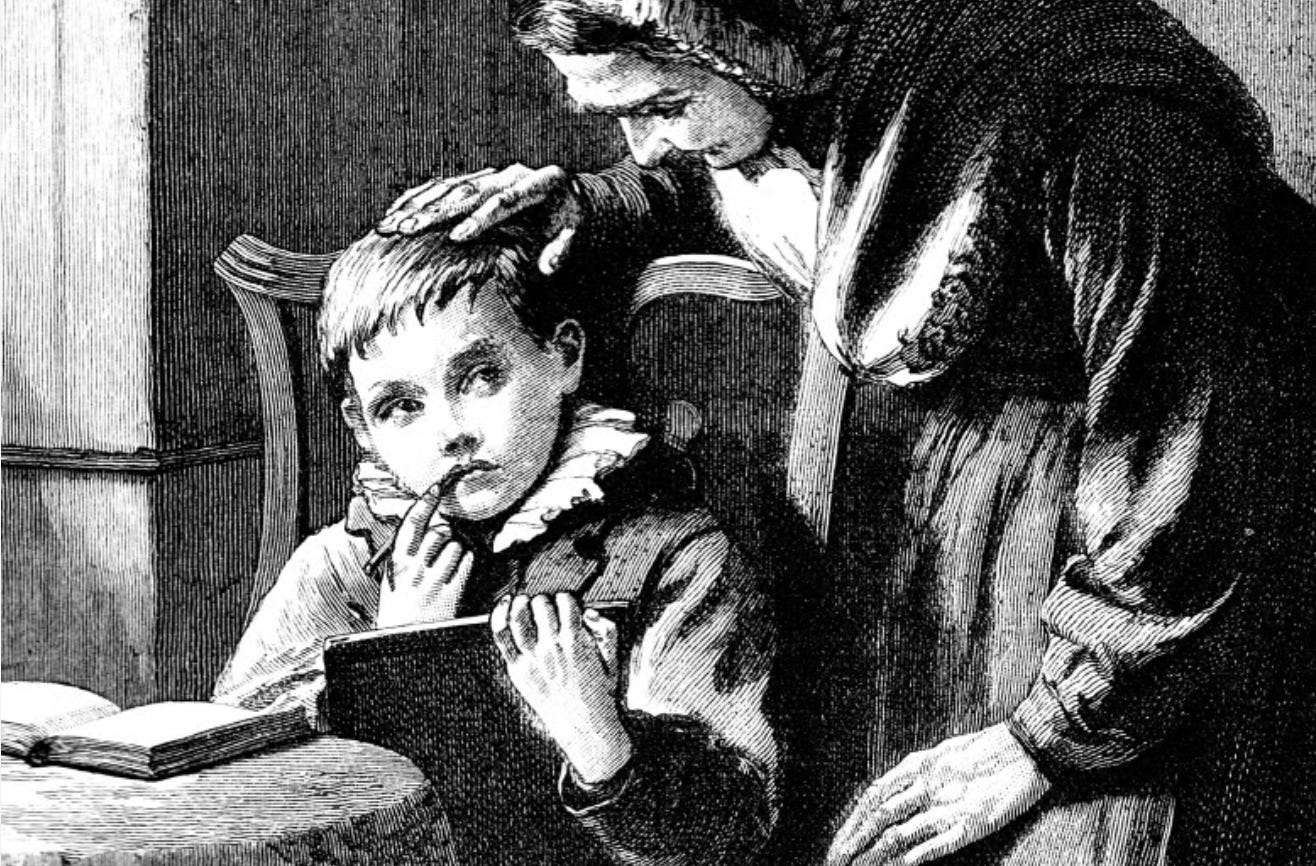
I wrote this for a newspaper, but alas it was spiked. Here are some thoughts on homework.
For many children, homework is a terrible bugbear. And now that we have Chat GPT and other Large Language Models, the question arises: why should pupils sweat over quadratic equations at home? Why not get their friendly bot to do it instead?
This, it seems, is the attitude of many millions of school children. A recent survey for Parent Voice Project has discovered that 57 per cent of parents think their offspring are using those pesky interfaces for completing homework tasks. Some children will even doctor their homework afterwards, using different software, to make it look like it’s been done by a human (which, if you ask me, is more bothersome than doing it yourself). Homework, it seems, may soon be as pointless as a radiator in the Sahara.
The topic of homework is a surprisingly hot potato. Some people can’t stand it. Why should children be forced to toil at home? Why can’t they run free or watch telly? There’s the social aspect, too. It’s all fine and dandy for those who can do it in comfortable homes with parental oversight; but what of those in cramped conditions, or noisy flats with parents who work shifts?
Either way, it’s clear that if children use LLMs to cheat, it’s hopeless for teachers. How can you instil in children the ability to research on their own, if they can’t be trusted with the most basic homework assignment? Homework consolidates knowledge, and it also encourages children to take responsibility for their own work.
I must be one of the few people in the world who reminisces fondly about homework. At my little boarding prep school, we had an hour every night, during which you could work at whatever you’d been set. It was a surprisingly peaceful time, with the duty teacher sitting reading a book. At my secondary school, the burden of homework was gradually shifted more and more onto our shoulders, until the sixth form, when it was entirely down to us. This was a great boon, as it prepared us for university.
But how will schools cope? It may be the case that because of widespread cheating, homework clubs will be introduced at breakfast or in the afternoon, even for sixth formers. This would certainly help hard-pressed parents, but it would remove the crucial self-starting aspect. You have to ask what’s worse, though: children faking their work, or being supervised?
I’m willing to place a bet that the old-fashioned elements like composition and public speaking will return to the fore. Teachers are already asking for handwritten essays to be begun in class and completed at home. Even the laziest pupil might find it not worth the bother to copy out an essay generated by ChatGPT in their own handwriting.
Whilst a focus on handwriting disadvantages those who need a laptop, there are also ways of using computers which track keystrokes. A teacher will be able to see if large chunks of text have been copied and pasted, or if the student has actually engaged. Teachers have also started moving back to in person assessments, relying on students memorising facts, and being able to debate in class the next day. And there’s already more emphasis on group work. If one member of a study group’s dropped the ball by using ChatGPT, then the others notice.
I don’t think homework will go the way of the pleiosaurs. We might even see positive results, as schools make more of an effort to instil into their pupils the need for self-reliance. Perhaps this is a case where technology, in moving us forwards, reminds us of the importance of all those ancient skills.
And if nobody can ever say that their dog ate their homework again - well, maybe that’s a good thing.