
On reading, re-reading, and re-re-reading [Essay]
What does it mean to read a book?

Since I began maintaining a list of books that I’ve read, partly as a record, but also partly to help jog my memory if I return to an author, the list has grown to near 1,600 volumes. I use these notebooks (eclectic in size, until I began using Moleskins) to trace patterns between novels; to identify themes; sometimes to recall plot or character. I am erratic in my notekeeping; some entries have detailed plot summaries, others don’t. Some say gossipy things about the author. Some consist, simply, of only a few impenetrable, gnomic words. They are numbered, and cross-referenced.
I don’t mention this to boast, but simply to demonstrate how much a person who fully partakes in the literary world, with all its myriad inkslingers and scribblers, might consume. And I imagine I am not alone in this.
The list began in October 2008 with Dag Solstad’s Novel 11, Book 18, a book I reviewed for the New Humanist; and its most recent addition is a children’s book, part of a round up I’m undergoing for Literary Review. Seventeen years; almost a hundred books per year; one book every four days or so.
Leafing through the list made me wonder what it means to read something. I admit that I have next to no memory of the Solstad. This is the bare note: “Compelling, perplexing, extremely moving but ultimately bleak”, which gives me nothing. Reading the review again provides not a spark of recognition: and I gave the book away long ago.
Can I then, reasonably, be said to have read it? I certainly did read it, seventeen years ago. I remember where I was: my flat in East London, the year my first novel had come out, and I thought the whole world would open up (as, in a way, it did).
I read the Solstad carefully and well enough to be able to produce a short essay on it. Given the hoarder that I am, I probably have kept the notebook in which I wrote down quotes and thoughts. But I wouldn’t be able to have a conversation about it now; I had, in fact, forgotten all about it, until I picked up my first notebook to begin this piece.
How much does reading involve memory? How long can one be expected to have a memory of a book? And what exactly do those memories entail? Plot? Character? Setting? Quotes? Leafing through my notes, I am assailed with sudden shafts of recognition: about Magnus Mills’ The Maintenance of Headway, for example, which I read in 2009. My note says “Entertaining allegory about buses”. Suddenly I find my mind swimming with familiar yet imprecise images. By contrast, The Death of King Arthur by Peter Ackroyd, in 2010, brings a sense of vague disappointment that someone could treat this wonderful material so badly.
When I read a novel again, I mark the note with an “r” for rursus: my notes tell me I re-read The Age of Innocence by Edith Wharton in 2011, and I apparently wept over the last pages in Yo Sushi in Victoria Station. This I don’t remember; but I do remember Newland Archer, and the terrible prison that he constructs for himself.
Reading, then, must involve some measure of re-reading. So, at a stroke, a huge percentage of those 1,600 novels and non-fiction tomes vanishes, and we are left with perhaps a few hundred or so books, which I have read more than once.
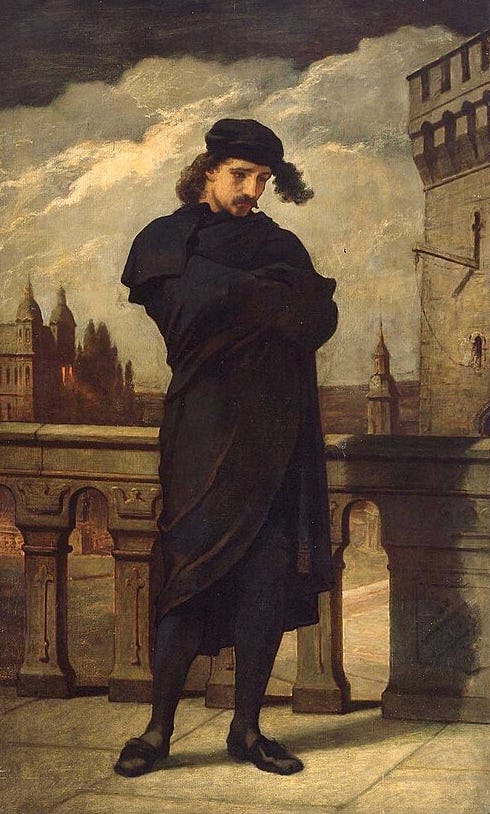
There is, of course, Shakespeare: when I read - studied - Hamlet for my A level English exam, I effectively memorised the entire play. I lived within its echoing, shimmering, dark architecture. I re-read it at university; I’ve seen it several times on the stage, as well as on screen; I return to it as often as a bee to a pollen-bearing flower. And yet, each time I re-encounter it, I want to read it more, and it still never feels as if I really know it.
Similarly, King Lear, a small copy of which I carry around with me: at university I had internalised it so much that my conversation was peppered with quotes: “tis a naughty night to swim in” became a kind of code between me and my friends for not wanting to go out. These plays, and most of Shakespeare, I can claim to have really read: and yet, and yet, there is still so much to do with them. I sense gaps in my knowledge: in my understanding of them: in my understanding of Shakespeare as a whole. I begin to see why people specialise: why they spend their whole lives immersed in one thing, and one thing only.
It’s the same with Homer: something I began reading, as a child, in translation, and then as a teenager in Greek; and then, at university, all the way through; as a tutor, I must have re-read certain passages dozens of times. Recently I began re-reading it in Greek, with the aid of a Loeb. It didn’t take long before I could look simply at the Greek without the aid of the English, those strange, harsh syllables forming images in my mind once more, and again I am standing in the golden halls of Troy, and Aphrodite is fetching a chair for Helen, and Priam is castigating his sons for liking dancing more than fighting. Why do I never grow tired of it? Does it change? Do I change? Does the act of observing the text more than once, like some mysteriously quantum act, alter its reality? Perhaps it does.
I resist, though, specialisation - for now. There is always the tantalising promise of another writer, another book, another time period, another country. And, of course, re-re-re-reading those books whose contours and contents are both as familiar as my study, and yet somehow remain as strange as distant, unexplored mountains, on a far planet, visible, yet ever unreachable. The only thing, I suppose, is to keep doing it: and one day, those mountains might feel like home.
Philip Womack’s children’s novel, The Arrow of Apollo, was republished today by Wilton Square Books.
This is a subject I've long wondered about. Why does memory fail us when we've loved a book? Or a film? What we remember is the impression it left on us, more than we remember the details of storylines, or dialogue or even images. Once interviewing Martin Scorsese to record the films he considered 'guilty pleasures' (there were hundreds!) I was horrified to realize that he remembered so many details about the films on his list, many from his childhood--films that I had also seen and loved, but from which I could at best remember only one scene, or one or two images. I think Scorsese is an exception. Even if we like a book or a film, we remember only those moments or images or stories that reach certain neural strings of our psyche, plucking those strings and recording the sound in our memory. There is much more to be said on the subject, but I'm glad you've brought it up, Philip!
As a re-re-reader but most emphatically not a note-taker, I found this very interesting - I had assumed that taking notes made books stay in the memory but evidently that's not necessarily the case. This makes me feel a bit less guilty about the many books I have devoured in the past and then instantly forgotten (sometimes to the point of picking them up again and only realising halfway through that I knew what was going to happen). I am a voracious speed-reader, the downside of which is that I sometimes miss bits. On the upside, it means that there is frequently something new to discover on a subsequent reading!