
The Liberators [Re-reading]
On looking again at early work

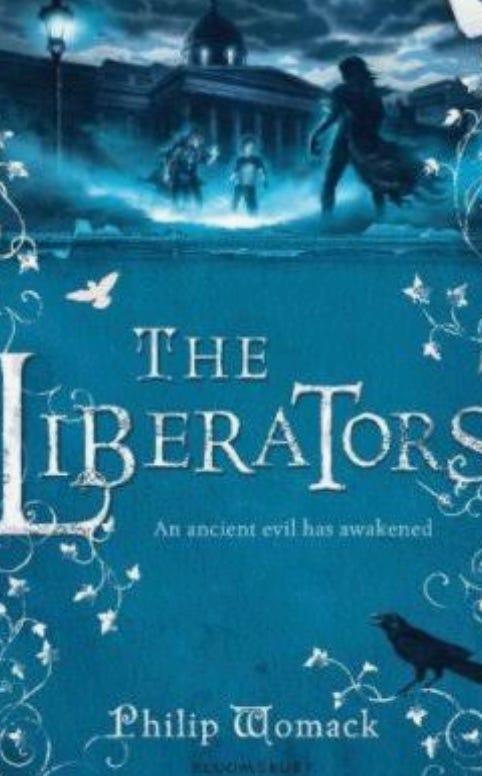
A friend - an old friend, as it turns out, although neither of us had realised, as we’d forgotten that we’d met two decades ago - has recently begun reading my books. This is always very nice, of course, as there’s nothing a writer likes better than talking about his or her own books to someone who has read and enjoyed them. He’d got through the ones that are in print, and was asking about the earlier ones.
I have, I supposed, quite a complicated relationship with my first five books. The first two, The Other Book and The Liberators, were published by Bloomsbury in 2008 and 2010, respectively, and were written in huge bursts of concentrated activity. Although I had two other jobs (at Literary Review, and tutoring), I was in my twenties, and had few other commitments. This meant that I could write as and when I wanted to, which usually meant in the very early morning.
Living, at the time, in Kensal Rise and then Shoreditch, I would rise at 5am, and walk through the early morning mist to the gym, before heading to the Literary Review offices, where I would pour myself into The Liberators from 7ish to whenever anyone else came in, and I’d begin the usual run of administering a literary magazine. I’ve never had such a regular or concentrated writing time since then: in fact, it seemed, almost, to exist outside of time, in a dreamscape, and perhaps I was dreaming as I wrote.
And indeed, those first two novels are very dream-like. Vivid, wild, and untrammelled, they move swiftly, interested in visions and things that lurk just outside of sight.
I hadn’t thought much about The Liberators until my friend asked me which of the early books he should read. And though I am very fond of my first novel, The Other Book, it’s The Liberators that I consider a better achievement. It is set in a contemporary London, itself beset by the ordinary terrors of financial crashes and riots, into which an ancient evil intrudes. The climax is at the National Gallery, a building which features prominently on the cover (I’ve always loved the cover, above, by David Wyatt; I wasn’t able, of course, to use it for the KDP version.)
So I decided to re-read it, mostly in order that I’d be able to talk about it once my friend had finished it, but also to see whether it still stood up, or whether it had faded.
I think the answer is, I was relieved to see, both. There are elements that appear clumsy or improbable to me now; but there are also many scenes which are full of tense, ambiguous danger, and there is a general overlay of the symbolic and the fantastic.
It begins with Blackwood, an agent for a secret society, being chased across London by some fearsome followers. He ducks into the Underground, and there, something awful takes place, and he is murdered.
It hadn’t really occurred to me until recently that I was channelling my own experience of the 7/7 bombings. I’d been staying in Vauxhall, and a friend and I tried to get onto the tube that morning to get to work. There was a power surge, everyone said, and so we decided to walk across the Bridge. There things started to become odd: there was a policeman on the bridge, who also said it was a power surge. Then I ran into an acquaintance who was crossing the bridge the other way - the tube stations there were closed, as well, and she was going to try to take the bus.
And so we decided to do the same; but they stopped the buses. I don’t remember if the news had got out by that point; but there were certainly several rumours going about. Bewildered, and as I was near Waterloo, I decided to go home to my parents’ house. I’ll never forget walking down from the station, past an enormous television screen, on which was being broadcast images of the bus that had been blown up, the entirety of its top deck destroyed. When I got home, I shut myself in my room, and didn’t come out for hours.
London, then, was thrumming with danger; by that time I had been living in London for three years, but I have never really considered myself a Londoner, having grown up in Sussex. This, too, was transmitted into my main character, Ivo, who is leaving his boarding school for the winter holidays to stay with an aunt and uncle in London. His parents are away on a research trip in Mongolia.
Ivo happens to be on the tube station platform when Blackwood rushes past him: and decides, on the spur of the moment, to give the magical object he’s carrying to Ivo to protect.
This is a coincidence, of course, and there are many such throughout the book. Ivo’s aunt and uncle live on the same square as the Rocksavages, whose children, Miranda and Felix, Ivo befriends, and whose bespectacled tutor, Perkins, turns out to be a vital player in the plots. Some might say that novels shouldn’t have coincidences in them: but my life in London has always been one coincidence after another. I run into friends on the street, on buses, on the tube. A chance conversation leads to a trip to France; a meeting on St James’ one year in the rain changed my life. Again, I realise now, I was transmitting that sense of my London life into the novel.
Trying to work out what the magical object is, Ivo also meets two brothers, Julius and Strawbones Luther-Ross. These were characters that walked into my imagination unaided: Julius is the more uptight of the pair, and Strawbones is glamorous and dangerous. They are rich and powerful and they turn out to be rather a lot more than they appear to be, for they are gathering acolytes towards them in the hope of bringing chaos to the world. I hadn’t quite realised, until I re-read the novel, that I’d unconsciously taken the name Julius from a character in an Iris Murdoch novel, Julius King, who comes to London and throws the lives of five friends into tragedy. Which is exactly what Julius Luther-Ross does. The name, incidentally, came from the Greek, Eleutheros, which means freedom. Only it is the wrong kind of freedom, and it turns out that they have drastically misunderstood the power of Dionysus, which is what they are trying to impose on the world.
London is also a character, as Ivo and his friends Miranda and Felix jump around from Kensal Rise (where another agent, the middle-aged Alice Hunter lives), to Marylebone, Oxford Circus and Holland Park. These were all my haunts at the time. When I first came to London, I had an A-Z, and I would highlight roads to help me find them; then I began highlighting all the roads I’d been down, perhaps as a way of owning the city. Again, I only realise now, that Ivo’s exploration of the city, his glee and his fears, also reflected mine.
The book’s cast also features Ivo’s aunt, an artist called Lydia, who is painting Julius; his uncle, Jago, a banker interested in chaos; an interior designer, Olivia Rocksavage, and her husband, a politican. It’s very much an upper-middle-class kind of London, which some (adult) readers thought would not appeal to “ordinary” children; but I never heard that complaint from children themselves. I wonder what fiction is for, if not to open a vista into something that is not in the usual run of things? And I was, after all, writing about the London that I knew: my London, a world of large, echoing houses, art galleries, theatre trips, parties in inventive places, encounters with people who turn out to be actors or politicians or journalists.
What I’ve always been interested in with my children’s books is sudden reversals, where people are revealed to be entirely other to what the reader has expected them to be. Perhaps this too is a reflection of how I felt about London: how its glittering surfaces can hold moments of embarrassment or even sadness; how you can find peace in cramped, cobbled alleys and amongst gleaming skyscrapers just as much as you can with the pelicans in St James’ Park.
The Liberators has a hopeful message (as I believe all children’s books should). If I were to write it again now, twenty years later, I would tone down the violence; but I don’t think children respond to violence in the same way as adults, and it’s sufficiently stylised or off-the-page not to have the visual impact it might.
Freedom, the book, argues, stems from what appears to be its opposite: the bonds that tie us to our family and friends. Perhaps this was my unconscious response to Iris Murdoch’s novel, which ends with Julius having succeeded in his machinations. Here, Julius and his frightening brother are destroyed, and London can breathe easily once more.
I haven’t set a novel in London since then. The Darkening Path trilogy takes place largely in a fantasy world; The Double Axe and The Arrow of Apollo in mythical ancient times; Wildlord is heavily influenced by Suffolk, and Ghostlord is set in a kind of semi-rural suburbia of a type which I think is badly served in children’s fiction. But maybe, now that I’ve spent more time in this enormous city - more than I’ve spent in any other place, it must be said - I’ll turn to it again. And maybe, this time, it won’t appear quite so frightening.
The Liberators went out of print a few years ago; grappling with my qualms about Amazon, I nevertheless decided to put it up on Kindle Direct publishing, where, if you want, you can read it for yourself. I’m glad it can still exist, even in that form.